I've crawled out from beneath my blog rock to acknowledge one of New Orleans finest, the great George Lewis. He was born today in 1900. A picture of George hangs on my dining room wall where I practice, and I often look to him for inspiration. You can read a lot more about him in a previous blog I wrote here: The Heroes—George Lewis
But mostly I want to sit and think about how George inspired my mentors, who in turn ushered me into this music I love and by which I make my living. Watch this video of him playing his composition, "Burgundy Street Blues." To George!
"Burgundy Street Blues"
Showing posts with label Tony Balluff. Show all posts
Showing posts with label Tony Balluff. Show all posts
Monday, July 13, 2015


Thursday, April 17, 2014
Skokiaan—Or—How A Motion Picture Influenced The Southside Aces
Watch The Impostors. I’m not normally given to issuing commands, but this is highly important. I’ve mentioned this 1998 movie in a previous post, Recognizing DCD.
The Impostors was written and directed by Stanley Tucci, and starring himself along with Oliver Platt. I’m talking about a fantastically funny farce that tells the story of two starving actors who find themselves accidental stowaways on a cruise ship. You need every single one of your digits plus a few of your cat's to count up all the shenanigans, which begin the moment the movie opens, and don’t end until the credits are done rolling and you start watching Terms Of Endearment just to balance out all the laughing. I’ve hurt my gut from the laughter each of the eight times I’ve seen it so far. Laughter hernias. Plus, I say PLUS, it’s all accompanied by a soundtrack that knocks me out every time. This is how I was introduced to one of my favorite Louis Armstrong recordings, “Skokiaan.” From the movie to my brain, my brain to the Southside Aces book, and now what do you know, we’ve recorded it ourselves.
But first let’s head back to 1947, when The African Dance Band of the Cold Storage Division of Southern Rhodesia released the original, the B-Side of which was a rough but spirited version of “In The Mood,” By the way, I’m serious, that’s the name of the band. I mean, it would be like if the Southside Aces were called The New Orleans Traditional Jazz Band of the Men Who Are Aces Department of South Minneapolis. I’m not here to criticize marketing choices, but just imagine the band stationery! How much you’d have to pay to make teeshirts! In 1954, the same recording was released under the band name Bulawayo Sweet Rhythms:

Doesn’t that feel better to your tongue? Can you imagine there must have been some days before the name change when someone asked one of the musicians what the name of the band was, and they started, “The African Dance Band of…oh, forget it.” Sometimes a man can’t be buggered to finish a sentence. The leader of the band, August Musarurwa, published his tune in 1952—
This is the sheet music I have...Secret Weapon!

—and the 1954 release became a nice hit for the Zimbabweans. The melodies and rhythms really are great. I mentioned "rough but spirited." The rough playing may have had something to do with the source of the title. Skokiaan is a type of African homemade liquor. It’s usually pretty harsh stuff, a single-day brewed moonshine concoction that can sometimes include ingredients like kerosene or battery acid…for flavor. When you listen to the Bulawayo fellas play it, notice how the trumpet enters at about 1:08 and only lasts about twenty seconds. Like a barstool debater, who interrupts with slurry eloquence to say what's already been said, and subsides shortly afterwards when he forgets he's the one talking. Spirited indeed. Too much skokiaan will do that to a person. I imagine him tipping out of his chair. I don’t have any proof of the high proof—the session may have been a sober affair—but I may or may not have personal experience with how a horn sounds after an unwise amount of imbibery.
The record reached the ears of the western world that year, and several diverse artists decided to cash in:


But my favorite, of course, was by Louis. His All Stars recorded it with the Sy Oliver Orchestra. If you compare the original instrumental’s great rhythms and melodies to the Armstrong recording, you can really tell Louis absorbed the Bulawayo Sweet Rhythms version. But he also sings! Where’d those words come from!? Now, here’s the thing about the lyric. An American, Tom Glazer, added words during the 1954 American craze for the tune. It comes off like an African tourist bureau song.
Oh, ho, Far away in Africa, happy happy Africa, (nonsense, nonsense, nonsense)…
Oh, ho, Take a trip to Africa, any ship to Africa, (nonsense, nonsense, nonsense)…
You get the idea. As far as I can find out, nobody consulted August to see if any insult was brought about by what I like to call “racist fluff.” “Skokiaan” was from that era of song when it was considered harmless popular diversion to write lyrics with minority stereotypes. But don’t underestimate Louis! He never was one to let a silly lyric get in the way of a superb performance:

Now here we are sixty years later about to put it on the next Southside Aces record! It was one of those where we go, "Eh, if we get a good take, we'll put it on the record." If it didn't make the cut, we wouldn't have exactly been despondent. As it turns out, it's becoming one of my favorites. It's a strong cut! We, however, dispensed with the singing. The Zimbabwe tourist office never got back to me. My arrangement, though, is obviously influenced by the Louis version; Zack even nails the high B-flats at the end. We’re in the mixing and mastering stage right now, so you’ll have to wait a little. In the meantime, get your hands on that movie, The Impostors. Do it! And if you can’t find it, let me know and I’ll have a screening over here at the house.
Monday, October 14, 2013
Recognizing DCD
“Oh wait! You have to hear this!” There we were, comfortably ensconced in the post-prandial, wine-sipping candlelight of my dining room, and instead of my friend being able to finish a sentence in a story of meeting a medicine man in the mountains of Guatemala, she has to listen to what Louis Armstrong does with his vocal at about 1:40 in “Hotter Than That.” Afterwards comes my excited response. It might be brief. Sometimes I’ll merely emit a sort of punched-in-the-gut noise when a musician achieves something that is unfair to all other musicians for the rest of time. The people who know me probably feel lucky when all they get is that visceral response. But many times a single moment in a recording acts upon my brain like the last left turn of a spanner wrench on a fire hydrant, and from my mouth streams a history of the recording, the musicians responsible, what the temperature was that day, and about the time they injured their leg. In this instance, to my meager credit, I remembered all on my own to wander back to the previous conversation and bid my friend to continue HER story. My etiquette, however, does not always rise up to being so barely adequate. Fortunately for me, my friends seem to love me despite this “charming” trait of mine.
I have decided to call this DCD, the DeVore Compulsive Disorder. I should probably ask my mentor’s permission before naming a disease after him, but I think he may understand. Do you suffer from this malady? This is a disease who’s chief characteristic is that no matter where a person is or what they’re doing, their ears will hear any and all traditional jazz no matter how faint, and said sufferers will commence struggling, or not, to squelch the urge to illuminate it’s presence. Charlie is stricken with an advanced case, wherein he displays all of the above, but also the symptom of providing music from his own head if there is none in his immediate ambient vicinity. He’ll also provide a song if you happen to string three words together that almost match one of the thousands of lyrics he stores in his noggin. I'm well on my way to this expression of the disorder.
"O-81, O-81. That reminds me of that Gershwin chestnut, 'Oh, Lady Be Good.'"

Despite all of that, I consider myself a good listener. In my previous career as a reflexologist working with patients in a hospital, my years of experience taught me to just be quiet and open my ears. That it’s best to not even tell your own stories of how you can relate to a patient’s pain and suffering. Doing that, in it’s own way, can diminish a patient’s narrative, and most patients want you to know what’s happened to them. The advantage in those circumstances was that in my twenty-four-year career, I think traditional jazz was playing within earshot maybe a total of four times. I almost never had that itchy feeling fever up my brain, making me want to ask questions in the middle of a session like, “Which Fats Waller is that?”
But I no longer do that work, and have been released into the world on my own recognizance. Maybe I’m sitting in a restaurant and my left index finger spasms up in the air, demanding the attention of those at my table as I stare into the middle distance. The middle distance is where I keep all my jazz esoterica. Somewhere buried in the noise of cutlery, other diner’s conversations, ice being restocked at the bar, and that patron yelling at the umpire on the overhead tv, the thread of a Sinatra tune reaches my ears. “That’s from his Columbia years,” I might let slip out of my piehole, while I nod appreciatively. Then I’ll oh-so-smoothly come back, my eyes refocusing. “You were saying?” I ask, as if I were the one waiting. I have actually perpetrated a version of the above scenario on an anniversary dinner. Again, I want to point out how I am a lucky man, having married someone with a high degree of tolerance for my disorder. Her tolerance is partly born of her own love of the music, but still, at our anniversary dinner? I guess, darling, I only have middle distance eyes, but not ears for you, as it were.
The same happens with soundtracks for television and movies. One of my favorite movies of all time is the 1998 film, The Impostors.
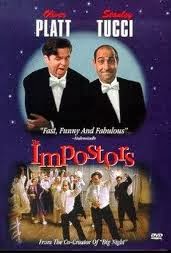
Throughout this fantastic farce, they use a 1962 Eddie Condon release of the song “China Boy” for the chase scenes. Other jazz recordings populate the soundtrack, including a brilliant use of an Armstrong recording of “Skokiaan.” The movie knocks me out every single time I see/hear it. Now that I've taken in about seven viewings, I largely restrain myself from comment, but that first time? I wonder how many times I said, “Are you hearing this? What a soundtrack!”
Yet another classic presentation of the illness may occur with live performances, especially those that are part of a party. In this case, based on true events, a musician—I’ll call him McHenry Henryson—thought it a lamentable state of affairs that another musician on the bandstand—whom I’ll call Sam Miltich—wasn’t being given full attention, despite his stellar playing on the song “Swing Gitan.” Understand that when I say “bandstand,” it was actually the space in a basement rumpus room formerly occupied by a ping pong table, and that same rumpus room was elbow to elbow with happy, happy wedding guests shouting, drinking, hugging, and otherwise celebrating the nuptials of good friends. Also understand that when I say “rumpus room,” I’m saying it pretty much so that I can use the phrase “rumpus room,” which makes me laugh. At any rate, McHenry’s desire was that one of the grooms be dragged from the middle of the fracas and planted directly in front of Sam’s guitar, so that he could know what kind of genius music was being played right in his very own rumpus room. I don’t really blame him. Many a time I’ve asked someone at a club if they heard the way the band did this or that, only to be given the I’m-sincerely-trying-to-remember look before they answer, “I must have missed it.” But I had to stop him from insisting.
His motivations are noble. This is not a man who bases his self-esteem on how many people at the party are paying rapt attention to the band. He is not an Artiste demanding, “Silence!” before a performance. We sufferers of DCD see our actions as a sort of public service announcement. For instance, there exists in our world the British Hedgehog Preservation Society. Their whole purpose is to bring awareness to the little buggers, essentially so that those folks who live in Hedgehog Land don’t run them over. There is even a Hedgehog Awareness Week in May.
Hedgehog Crossing
I didn't know they carried bindles.

This makes two blog postings in a row where hedgehogs have come up. I think I have an infestation. Anyway, whether it’s me at a candlelit table, or Charlie in a movie theater, or McHenry Henryson at a rumpus room reception, we’re just providing the same service. Jazz Awareness. “Look! Jazz!! Don’t run it over!” Where our nobility falls flat, however, is in our utter disregard of the etiquette of each situation. A man shouldn’t oughtta drag his friends away from their lives every time he hears the Bix and Tram recording of “Singin’ The Blues.” Of course, those of us with terminal cases of DCD believe that it’s everyone else in the world that is failing to observe proper etiquette for when jazz is crossing the road.
As the years go by, it occasionally occurs to me that there are some areas of my behavior in need of improvement. In the case of my DCD, I have had to develop a conscious ability to be aware of my surroundings and maintain a state of repose when confronted by the tunes about which I’m so keen. I once had to actually tell myself, “No, Tony. Right now you don’t need to mention how amazing it is to hear the Bechet/Spanier ‘Four Or Five Times’ in a coffeeshop. Let your friend tell you about his seasonal depression.” To my friends, I would have you all know that I truly do value your conversation and your company. My distraction has nothing to do with a boredom brought about by the stories of your days. I always want to know what’s going on in your lives. It’s purely a mechanism of my brain and spirit that automatically lights up when I hear this music I love. But I love you more. Really, I do. Really…Oh! But check out Barney Bigard on this trio recording! Zutty Singleton’s on drums and…
Here are the other links to the highly distracting soundtrack for this post:
Sunday, September 29, 2013
A Decade Of Aces: Part Nine '13
This is the Ninth and final installment in a series of historical retrospectives covering the first ten years of the Southside Aces, in celebration of their tenth anniversary.

It took a while for me to recover from our big tenth anniversary party last month and find my way back to the last chapter of this story. According to the people who make this stuff up, a tenth anniversary is often celebrated with aluminum. I tried to get the Aces an Alcoa sponsorship, but my “Does your local jazz band shield their homes with aluminum?” ad campaign fell on deaf ears. So did my offer to change the band’s name to “South Siding Aces.” Some ideas take time to gain acceptance.
It took a few weeks before we touched down in 2013. We re-entered that hallowed hall of ribs-and-such called Famous Dave’s. We were offered more money and a year’s worth of dates. Our previous negative experience was just enough in our past for us to say yes, so there we were. I decided we would go in there as the “Southside Aces Big Five,” always as a quintet, to make the money slightly better for each man, and to give guys the option of not always playing. Famous Dave’s didn’t exactly come off firing on all cylinders for us this first night back, advertising us as “Jack Knife and the Sharps.” A bemused band, we. At the end of the first set, Erik introduced Zack as “the brass knuckles of the band,” me as, “the Secret Weapon of the band,” Robert as, “Mr. Class,” Dave as being “all the way from St. Paul, Minnesota,” and himself as “Santa Claus on the Santaphone.” The legend continued.
Our appearance at the Eagles was considerably classier than usual. And Robert wasn’t even there! A satellite looking down on that portion of the earth would have detected a huge surge of sophistication beaming from the south ballroom. A Johnny Mercer flare. Maud Hixson and Rick Carlson joined the Aces to feature the music of that Savannah legend, from “Moon River” to “I’m Old Fashioned,” to “That Old Black Magic.” Maud and Rick were incredible, as were the raffle prizes. Mercer’s hometown is also famous for it’s hushpuppies, so one lucky fan walked home with a $1.99 package of hushpuppy mix. Like I said, classy.
Some hot oil away from deliciousness!

The jazz was played on the first Monday of February at Famous Dave’s, with Steve Pikal on bass and Reid Kennedy on drums. We launched with “Under The Bamboo Tree,” and stuck a fork in it with Kermit Ruffins’ “Goodnight.” How’s that for a 95-year span of jazz? In between we comported ourselves well on tunes such as “Blue Again,” “Comes Love,” and a very hot “China Boy.”
Check out Kid Ory on that 1901 classic, “Under The Bamboo Tree.”
The following Sunday found us the unfortunate recipients of a huge, wet snow storm, which fell right on top of our Mardi Gras Tea at the Sokol (Czech Hall) in St. Paul. Not enough folks emerged from their hibernaculums to ensure the Sokol a profit that day. I believe I still take issue with the people who were scared off by the snow, on account of the example our good friend, Mimi, set by driving TWO HOURS from Wisconsin so she could get her second line on. Let that be a lesson to you people! A good ol’ time was had nonetheless. The Southside Aces with New Orleans caterer Cajun 2 Geaux in a beautiful 1897 hall made sure things were done right. From “If Ever I Cease To Love” to “Mardi Gras In New Orleans.” Jim, one of our fans, gave us one of the best compliments a performer can receive. “You guys! You could have folded up your spirits with this small crowd. Back in my younger days, I played in a crummy scab band and we couldn’t hack a small crowd. But you guys just shined, played all out!” It’s my blog. I can let you know when someone is patting me and my band mates on our respective backs if I want to.
One of six stage backdrops at Sokol Hall painted in 1932

Mardi Gras proper found us doing our “Thirty Minute Brass Band” routine in between Cajun bands at the Eagles again. The Aces with Chuck DeVore on snare, and Wittacee on sousaphone. Six musicians, twenty-seven minutes, three hundred dollars. Wittacee had received the call to sub for Erik less than an hour before we played. I met him at the bar, handed him a PBR Tallboy and $60, ten dollars more than everyone else received. “You get the twenty percent bonus for the rush job,” I told him.
I entitled our Valentine’s dance at the Eagles, “Sweethearts On Parade.” Unprecedented in our history was our online auction of a romantic night for two. Peg and Emily won this unbelievable prize package: two entries, a table for two up on the stage with the band, pizza from bartender Royal’s toaster oven, two vending machine deserts, $2 in quarters for the skill crane (Peg actually won something called a “Love Bear”), ten song requests, with the band committed to honoring two of them, and three opportunities throughout the night to yell “Hit it, boys!” All of that was beside the raffle! A heart-shaped tin of strawberry lollipops with Yoda on the lid, Valentine-colored peanut M&Ms, chocolate-covered dried Bing cherries, an oinking Valentine pig that pooped candy into a tray by it’s butt, and a pair of predominantly red Popeye boxers that said, “Thinking of you” across the butt. Oh yeah, and we played some music.
On March 1st, we traveled to Des Moines to play the Heartland Swing Festival. I recommend Velma’s homemade rhubarb pie that she sells out of the second story of the red barn that is the rest stop part of Diamond Jo’s Casino and rest stop off of 35. I had that with some Dr. Pepper and Cheetos. I bought the Cheetos so I could get some protein in my lunch.

We featured the music of Fats Waller at the Eagles, with pianist Steven Hobert subbing for Robert. Before the show, Dave tells me a clove of garlic fell out of his suit when he took it out of his closet. This from the late night pizza we had after the last job. There’s where a fella can be happy he didn’t have his suit pressed between shows. We began the feature set with “Ain’t Misbehavin’.” Erik wanted to announce it as Waller’s “most popular hit.” I told him it wasn’t necessarily true, and Zack made sure I remembered how much of a nerd I am. Erik announced it as, “arguably his most popular hit.” I washed my hands of him, saying, “I ain’t protecting you from the Charlies out there!” referring to how Charlie DeVore was sitting fifteen feet away, and would probably know exactly which tune topped the Fats Waller hit parade. He and Zack laughed at me. Erik displayed mock fear, “When we’re done, I’m just going to run out of the building, talk to no one!” The very next song, “Honeysuckle Rose,” he also announced as, “arguably his most popular hit,” thus diluting his original declaration, and perhaps saving him from the wrath of historians.
In April, Henry Blackburn gave us what for on our show, “The Alto in Jazz.” Captain John Handy, Joe Poston, Harold Dejan, and “Singin’ The Blues,” Frankie Trumbauer’s famous recording. I know Frank was technically on a C-Melody saxophone, but who—except for you three people who sent me emails— is going to argue? Among many greats, the crowd heard “You Can’t Escape From Me,” “Ice Cream,” and “Curzon Hall Boogie,” a tune I got off of an album Henry did with Kid Dutch. Henry told the story of how I had asked where Curzon Hall was in New Orleans. The piano player on the date with Henry was named Andrew Curzon Hall. Not a place but a man! Erik said, “I hope someday someone names a song ‘Owen Jacobson Boogie.’”
We played Famous Dave’s in May with Keith Boyles on bass. Zack wanted to dig deeper into our book, so I took him at his word and called several that don’t usually come across our desk. A couple of Irving Berlin numbers, including “The Song Is Ended.” When I sang my high E flats on that one, it sounded like someone was cinching me too tightly. “Jazz Me Blues,” Bix style. A King Oliver “Riverside Blues.” In the second set, I called three from the A.J. Piron repertoire, “Red Man Blues,” “Bouncin’ Around,” and “Mama’s Gone Goodbye.” Keith admitted that he’d been liking the repertoire, but he begged, “Tony! Can we play something I know?” Zack chimed in, seconding the motion. I looked at them, perhaps a bit too triumphantly, and said, “I broke you guys! I broke you!”
The Guitar in Jazz was our feature at the Eagles. We added guitarist Dean Harrington in order to hot club it up. We played “Montmartre (Django’s Jump),” and a great version of “Nuages” with the stormtrooper introduction. Our instrumentation on “Minor Swing” was Zack on rhythm guitar, Dave playing brushes on HIS guitar, Dean, Robert and Erik. Four guitars and a sousaphone. That can’t have happened before. Robert did the famous Santo and Johnny solo, “Sleep Walk.”
For the raffle, I had done my research. One of Django’s favorite foods was roasted hedgehog, or as he knew it, “niglos.” I even found a recipe for it’s traditional preparation. Needless to say, however, I didn’t have time to find, kill, herb up, roll in clay, throw in a fire, de-quill and package one of the little darlings, so I settled for a large bag of in-the-shell peanuts and a best of Django recording. The peanut bag was at least in the shape of a hedgehog. Erik told the crowd I had made a mistake not calling him first. He said, “I have hedgehog.” Then he added, “I’m not saying it’s fresh…”
Uncooked hedgehog

The Aces played at the Dakota on Mother’s Day. Craig Eichhorn told me “It’s not a performance, but it’s not a background job either.” Somewhere between the spotlight and the potted palm, I guess. I remember the incredible grits they made that day. We had Matt Peterson on bass both for that one and the June Famous Dave’s. Matt and Robert spent every non-music moment talking feverishly about their other shared passion, bikes.
On the sixth we played at the Harriet Tap Room over on Minnehaha Avenue. We were able to partake of their beer, and Chef Tim from Cajun 2 Geaux brought his food truck out and was very generous to the band. It was a bit cool and damp for June, but not unlike most of the nights by this halfway point of 2013. Steve said with a straight face, “This winter isn’t going too bad.” We had a regular sound check. “Kick,” said the soundman, and Dave played his bass drum. “Set for the overhead,” said the soundman, and Dave flailed around on the rest of the drums. “Oboe,” said the soundman for me, and the band cracked up. Zack called me “Kid Oboe” that night. Outside of the comedy highlight, we knocked out a sweet version of “Smoke Rings,” like you do when you play in a brewery.
The Minnesotan legend, cornetist Doc Evans, is whom we featured that month. We recreated the record that was made of his 1953 appearance at the Walker Art Center. We began with one of Doc’s quotes regarding how he was happy to play anywhere: “Jazz doesn’t know where it is, and it doesn’t care.” Then we launched with “Under The Double Eagle.” Doc tended to play with West Coast Dixieland tempos, meaning that they really stepped on it. Be careful not to fall off the back of the truck! But the Aces are the Aces, so we marked the difference between Doc and us right off the bat. Our “Double Eagle” had a groove, despite it being an 1893 march. Charlie DeVore came right up to the stage upon the last note to shake my hand. “That was the perfect tempo!” he extolled. “None of that racehorse business with you guys!” In response, Erik said on mic, “You have to feel pretty good about the way you played a song when Charlie DeVore comes up and shakes the band’s hand!” As an introduction to “Muskrat Ramble,” Zack had Erik tell this story to the crowd:
“We’re all adults here right? So, the other day Zack was standing on a bank doing some fishing when he noticed a couple of Muskrats, well, in a romantic situation.” I said in an aside to Zack, “A ramble, so to speak.” Zack got up to finish the story. “When they saw me, the male muskrat ran back into its cave, and the female was so mad at me for the interruption!”
Muskrat, perhaps angry, I'm not sure

We had a rehearsal at my house for an upcoming big show at the Old Log Theater in July. With twenty tunes to get through, I set the bar low for what passed for moving on to the next song. “That’s my goal,” I told Rick Carlson, “a minimum of familiarity. That way, when the band has entirely forgotten about the music by next month’s show, they can open the books and experience déja vu.”
July Famous Dave’s featured the Southside Aces Big Four Brass Band on account of Robert being in Wisconsin at the start of the night. I, too, once received that phone call that gives you that terrible sinking feeling, when someone tells you that you aren’t where you signed up to be. But we rolled with it just fine. At the Eagles the next week, we featured the music of Benny Goodman, with Keith Boyles on bass and Rick Carlson on piano. My personal pantheon of clarinetists tends toward the New Orleans men, but the King of Swing has been impressing my listening ears as of late, especially his small group recordings. We performed tunes like “Shivers,” “Pick-a-Rib Part 1,” the trio version of “Oh, Lady Be Good,” with the four key changes, and “Slipped Disc.” I had a ball!
The Southside Aces Big Four—this time Zack, me, Robert and Steve Pikal on bass—made our way down to New Ulm to please the denizens of that famous German town at the Grand Café. Steve is the nephew of a legend in those parts, Wally Pikal. Wally was famous for being able to play three trumpets at the same time while on a pogo stick. When I told Zack this, he sort of frowned and said, “Why would you do that?” I also remember how we couldn’t fulfill five requests in a row. FIVE. The crowd still liked us that night, but I’m not sure if they trusted us.
On July 15th, we went into the Old Log Theater with Maud Hixson and Rick Carlson to do it up in large fashion on the music of Johnny Mercer. This was one of the last shows in which owner Don Stolz involved himself. He had sold the theater after 73 years of running things! Maud and I began collecting what we called Don Stolz Hangups. Don is great to work with, but we had to accustom ourselves to his way of using a phone. The second he obtained whatever information he needed from us he would hang up. No wasting time on the usual niceties. For instance:
Me: “So do you write up a contract, or would you like me to put one together?”
Don: “Could you do that?”
Me: “Sure. Where…”
Click, dial tone
Or the time Don called Maud to ask her to change the date:
Maud: “I’m looking at our calendar, and that looks fine with us.”
Don: “You’re a good girl! And I love you for it!”
Maud: “Thanks, Don, I lo…”
Click, dial tone
We would always find ourselves finishing sentences to a dial tone. We sort of became perversely proud of these. “I got another one!” we’d say when reporting in to each other. At any rate, we were very grateful to Don for having us out there. I really felt like it was a magical night, and a perfect place to present that music. Maud sang beautifully, Rick made you go “Dang!” and the band proved we belonged in a concert hall just as much as we do a joint. Charlie DeVore made an appearance as well, laying us all low with his rendering of “Strip Polka.” This was one of my favorite nights as a musician.
At the end of July we played for Abbot Northwestern Hospital in what’s become an annual occasion. The beginning of August had us at the Social Dance Studio on 23rd Avenue and 38th Street and, of course, Famous Dave’s. Steve Pikal subbed for the rib joint hit. I think Erik is going to drop in on that job maybe only once every four months or so, like a retired uncle who comes back into town from his travels once in a while to tell stories and hand out souvenirs.
Speaking of stories, this wraps up ten years and brings me up to the actual anniversary show. I’ll have to tell that one another time. For now, I want to thank all the fans who’ve made it out to a decade’s worth of the Southside Aces. I am always grateful that I get to play this music I love so much, and that there are people who want to hear it. And I want to thank my fellow musicians for being such good Aces. To another ten years! Cheers!
Wednesday, July 17, 2013
A Decade of Aces: Part One '03-'04
This is the First in a series
of historical retrospectives on the Southside Aces, in celebration of their tenth anniversary.

Nobody can really believe it. When the Aces slouch into the Eagles on August 8th, it will have been ten years nearly to the day from when Erik and I first met to discuss the possibility of getting a band going. How often do you hear about a band getting to celebrate a ten-year existence? Some people have shorter relationships with their spouses. Or even their cars! Well, we intend to do it up proper. Over the next few weeks, I will put on record the salient features of our decade as a band. Secrets revealed! Dark, sinister dealings brought to the light of day! Ok, sinister is a tad strong. If there had been a deal with the devil along the way, we’d be playing our anniversary show at the Fitzgerald or some other high tone spot. Not that I don’t have warm fuzzy feelings about the Eagles…oh, you know what I mean. Anyhow, the most sinister dealing we ever had was the night at the Times when we kept handing cash to the bartender for a drink called “The Haymaker.” Erik also cajoled the crowd into buying them. I think he told the crowd “Buy ‘The Haymaker’,” more often than he told them to buy our CDs. The Times didn’t sell enough of that lime and whiskey and something-or-another drink to stay open, obviously, but it wasn’t through lack of trying on our parts! But I do get ahead of myself.
Fate
Somewhere near the beginning of 2003, Erik found himself at a party talking to a man named Adam Fesenmaier. Both being musicians, they talked about their respective musical experiences and wishes. Something Erik said reminded Adam about a guy from his distant past with whom he used to work in a furniture warehouse. It had been a handful of years or more, but what the heck, he tracked down his number and called:
“Tony?” he asked. After inquiries about health and happiness, Adam said, “Say, the reason I called you is I ran into this guy at a party who plays sousaphone. He told me, and I quote, ‘I’d really like to play in a New Orleans dance hall band’ whatever that means. But it made me think of you, so I got his number. He told me you should call him.” It was that tenuous thread that sewed Erik’s and my fate together. Thank you for following up, Adam!
The Name
It took a few months of living our lives before we managed to get together, but on August 10th, 2003, Erik and I met. A week later, on August 17th, was the first rehearsal of what would become the Southside Aces. It took a couple weeks to name the band. “Southside” was going to be part of the name right from the get-go. Both Erik and I make our homes in South Minneapolis, and Erik always wanted to name a band “Southside” something. “How about ‘Southside Six’,” he suggested. “I’m uncomfortable naming bands with numbers,” I said. Friends will tell you I can be a worrier. “’Cause then you sometimes have to play with four or five guys, and some smartass comes up to you and says, “I see you are a quartet; how come you call yourselves the Southside Six?” I had been listening to Jabbo Smith that week. He was a trumpet man of the thirties who once ran a band he called The Rhythm Aces. “What about the ‘Southside Aces’?” I asked. We liked it. It stuck.
First Days
On September 20th of that year, we had our first job. We played out in an Apple Valley parking lot on a stationary flatbed truck for the Ring Around The Arts festival. This was not the type of propitious beginning that would cause you Nostradamus types to predict tenth anniversary shows. But at least the truck was stationary. The lineup was me, clarinet; Zack Lozier, trumpet; Erik, sousaphone; Robert Bell, guitar; and Joe Steinger, drums. See?! There were only five of us! Southside Six, indeed! Steve Sandberg would be our trombonist, but he couldn’t make it out to Apple Valley that day.
The band went through their first handful of months without officially hiring a drummer. Different guys cycled on and off the drummer’s chair, through jobs with Le Cirque Rouge at First Avenue, where we wowed ‘em with “The Mooche,” and our first job at the Times on December 20th. Finally, in February of 2004, Dave Michael and the Aces tried each other out. He first played with us at Jitters, the basement below the Times. Each guy received $20, food and beer. If any of you remember Jitters, you’ll recall it had a tile floor and corrugated aluminum flashing for a stage backdrop. Dave recalled, “It was like playing in a Chipotle.”
The Ted
We played the Times a couple of weeks later, on February 21st. This was the first time we had a sub. I hired Ted Schryer to play tuba in Erik’s stead. When we all gathered for rehearsal after that show, we gave Erik hell—“Oh, Erik! You should have heard Ted! I just loved how he played “Hindustan!” Ted really knows what he’s doing! It was just great to play with Ted!” We went on and on. Finally, Erik had had enough. “You wait ‘til you guys get your Ted!” he warned. For a few years, whenever we needed a sub we’d say, “Did you get a Ted for that job?”
KGC Records
In May, we played for Longfellow Elementary over in St. Paul. This job is famous for being the source of the name of our production company. When I say “production company,” I mean to say that we’re still waiting to move into our first office. But if you notice on all our CDs, it says KGC Records. Around about the middle of this gig, we played “The Mooche.” All those elementary school age rugrats running around the place. Erik announces on mic, “Kids go crazy for ‘The Mooche’!” Kids Go Crazy. KGC Records.
The First Release
We’d recorded a demo in Robert’s attic in the fall of 2003, but our first real effort wouldn’t happen until a year later. In the autumn of 2004 we brought engineers out to two live shows. All Aboard!, our first record, was made from the best songs of those batches. On October 2nd we recorded at the Times, and on the 23rd at Lili’s Burlesque Review. Well, it was Lili’s space. That night there weren’t any dancers, just microphones and a crowd. If you were at those shows, you are an indelible, audible part of our history. Our traditional jazz CVs were kind of meager at that point. But even when I listen to that recording today, I’m comfortable with the amount of wincing I experience. This brings me to the end of 2004. There'll be more in the days to come, but for now I'll leave you with this image. Weren’t we just cute?

Sunday, May 12, 2013
The Potted Palm Job?
A bleary-eyed but smiling man in a black suit, white shirt and yellow tie with matching socks, could be seen strolling into the Dakota earlier this morning. He was certain he appeared bleary because he didn’t want to hold more than one eye open at a time. Whiskey is a good agent for warming the bones after spending time playing a clarinet outside on an unnaturally frigid May wedding night, but it’s not a good beauty tip for your morning-after eyes. True story. And I’m the hero.
The Southside Aces played at the Dakota on this Brunchtide, a Mother’s Day shindig:

—By the way, check out what I got to put in my pie-hole:
Family Style First Course
deviled eggs, apple+manchego scones, house baked mini muffins & breads, pickled green beans, fried green tomato, apricot jam
deviled eggs, apple+manchego scones, house baked mini muffins & breads, pickled green beans, fried green tomato, apricot jam
Sweet Creamed Grits –blueberry doughnut toast, roasted cippolini onion, glazed yam, crème fraîche, blueberry jelly
Banana Cream Tart
toasted meringue, peach butter, strawberry+tarragon salad—
toasted meringue, peach butter, strawberry+tarragon salad—
(Are you kidding me?!)
Ahem. Back to my story. The aforementioned “strolling” of the man in the black suit was an affectation to cover up what was more of a shamble. I was smiling out of that sense of security that comes with having made it to your destination. Once I was able to sit down peacefully in the green room backstage, I worked on forming connecting thoughts, so important when you’re playing jazz! After a half hour of that, however, I found out I’d only written down four songs on a piece of paper. At that rate, had I persisted, I wouldn’t have finished the set lists until it was time to leave. “I could go for some deep, untroubled sleep right about now,” I said out loud.
But the other men began to arrive, and I perked up. Matt Peterson came in with his string bass in place of Erik and his brass bass. The rest of the band was made up of the usual suspects—The French Tickler, Psycho Stevie, Mr. Class, The Moral Compass and myself. Zack, Steve, Robert and Dave all seemed equable, despite the somewhat distressing hour of 10:00 a.m. Matt, on the other hand, actually went beyond that into a sort of eagerness. I didn’t trust it. Who was this man so hale and hardy of a Sunday morning? I would have to keep that one eye I had open on him.
Dakota soundman Craig Eichhorn had instructed me of my brunchly duties. “You’re background, but not really background. A little bit more than background. But it’s not a performance either.” We understood each other. I think he wanted to make sure I wasn’t shooting off pyrotechnics and waving flags in attention-grabbing semaphore. The Moms just want to eat their brunch and maybe hear a couple of good tunes!
Just for a second or twelve, if you don’t mind, I’m going to take a little sidetrack right now. I like to call background/ambience type work the “Potted Palm,” as in, “Yeah, tonight I’m on a Potted Palm job.” You know, where your music makes things a little nicer without a person necessarily being able to pin down why. The other end of the spectrum would be a showcase or feature concert. I like to call those shows “The Big Shoe,” a loose reference to the funny pronunciation Ed Sullivan sometimes had when he introduced his “really big show.” For instance, I might say, “I can’t wait for the Big Shoe tonight.” Of course, when I’ve used this phrase, generally the only person I don’t confuse is myself. Maybe it’s because I have big feet, so people think I’m literally talking about a shoe. Or maybe these days Ed Sullivan is too far beyond the ken. I don’t care; I’m sticking to it! But what about this morning? A show that falls between the two designations? I don’t yet have one for that. Maybe I could say I’m “Chopping Parsley.” You know, it’s definitely a flavor you’ll use in a dish, but it’s never the main flavor. Hey! Climb off! It was my first attempt!
At any rate, we did some fine work. The boys kept it subdued for most of the first set. This was good for everyone’s health, as it both served to slowly introduce the idea of a jazz band to the nervous systems of the diners, and to prevent we men in the jazz band from pulling a jazz muscle right out of the gate. We did, however, heat it up several times throughout the day with numbers like “Diga Diga Doo” and “Tootie Ma Is A Big Fine Thing.” You say you don’t really remember those songs being in the Mother’s Day cannon, but I want to point out how it actually says the word “Ma” in the latter tune. My favorite moments, though, were the sweet ones. A Louis Armstrong-inspired “Red Sails In The Sunset.” Evan Christopher’s achingly beautiful composition for a dearly departed friend, “Waltz For All Souls.” But perhaps my absolute favorite was “All Through The Day.” It registers high on the Sweet-O-Meter, with Oscar Hammerstein’s story all about thinking and dreaming of your loved one the livelong day until you can get home to that kiss. We didn’t give it the Frank Sinatra treatment—just instrumental. But Jerome Kern’s melody tells that same story all by itself. I especially love when it comes out of the bridge, changing keys for just three bars, restating the main phrase in the new key. It’s as if your heart needed more room to hold all that love and yearning, and only by changing keys would you be able to keep it all together! Oh boy, I’m a sucker for the sweets!
I think I’ll leave off with that. I want you to hear Frank’s version of the tune. He really does it some justice, I think. And next time you’re around this bleary-eyed, smiling man, go ahead and inquire about hearing a jazz band play it. Happy Mother’s Day!
P.S. I'm also welcoming suggestions for what to call it when it's not background, but it's not performance. I may not be going with "Chopping Parsley"...
P.S. I'm also welcoming suggestions for what to call it when it's not background, but it's not performance. I may not be going with "Chopping Parsley"...
Subscribe to:
Posts (Atom)